
News
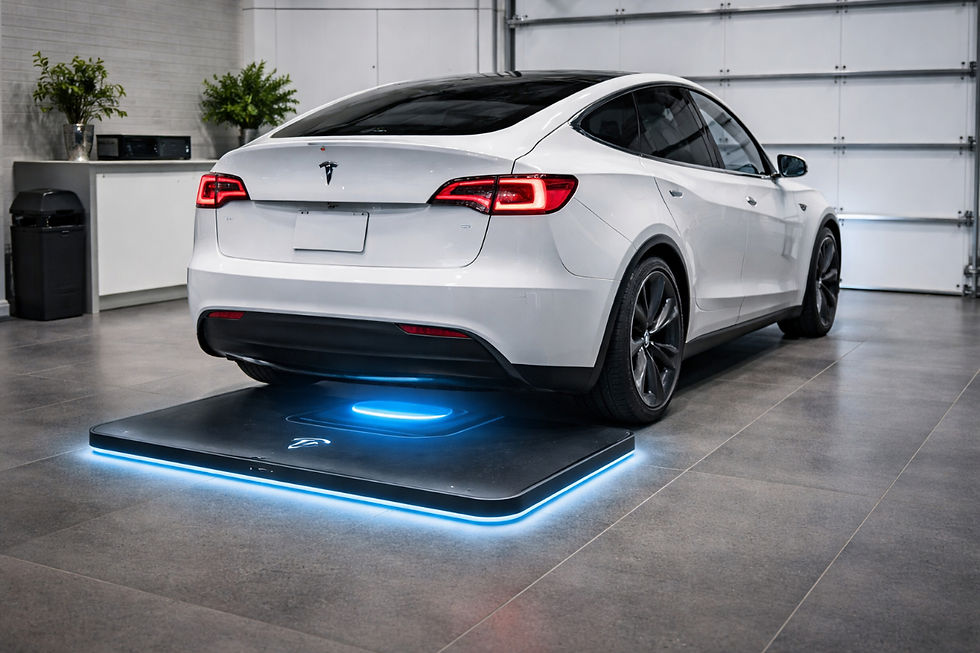
Tesla secures FCC waiver for wireless Cybercab charging system
Disruption snapshot
The FCC cleared Tesla to use fixed outdoor UWB for wireless charging. Cybercab can align and recharge autonomously, cutting labor and boosting daily operating hours.
Winners: Tesla’s robotaxi model and fleet operators seeking lower costs. Losers: Plug-based charging providers and automakers without embedded charging ecosystems.
Track cost per charging pad. If it falls near $2,000 installed, fleet math works fast. If it stays above $5,000, expansion slows.
Tesla (TSLA) just turned the driveway into energy infrastructure.
The FCC handed Elon Musk the missing permission slip.
Wireless charging is now part of the Cybercab business model.
On Wednesday, the first Cybercab rolled off Tesla’s Texas production line. It’s a two seat autonomous EV based on the Model Y platform, with no steering wheel or pedals, and a human safety monitor for now. Musk says it will cost under $30,000, a number that would undercut most new gas cars in America and beat many EV rivals by $5,000 to $10,000. Chinese EVs recently surpassed Tesla in global sales, but this can change the narrative.
The bigger move came from Washington. The FCC granted Tesla a waiver to use Ultra Wideband radio in a fixed outdoor wireless charging pad. Under existing rules, that kind of UWB system had to be handheld. Tesla needed it embedded in the ground.
The system works like this. The car finds the pad over Bluetooth, then activates a short burst of UWB to fine tune alignment. Once positioned, wireless power transfer begins. Low power, short range, minimal interference, according to the FCC.
The disruption behind the news: Charging without humans is the real autonomy breakthrough.
If Cybercab is meant to operate as a high utilization robotaxi, human plugging doesn’t scale.
Every manual plug adds labor, downtime, and failure points.
Wireless charging turns refueling into software.
That matters when a vehicle is targeting 16 to 20 operating hours per day.
At $30,000 per vehicle, Tesla is signaling a capital cost that could sit below the average new car price in the US, currently above $45,000. If a Cybercab runs 60,000 miles per year in fleet service, fixed charging pads in depots eliminate thousands of human interventions annually. Even saving 5 minutes per charge across two daily sessions equals more than 60 hours of reclaimed operating time per vehicle each year.
Now scale that to 100,000 vehicles. That is 6 million labor hours erased.
The FCC waiver sets precedent. Regulators just proved they will adapt spectrum rules for autonomous infrastructure. That lowers friction for other embedded radio systems tied to robotics, logistics, and smart cities. Tesla didn’t just win a technical approval. It nudged federal policy toward machine to machine environments.
There is also lock in. A ground installed charging pad is not a generic asset. It is tuned to Tesla’s vehicle geometry and communication stack. Once cities, parking operators, and fleet depots install thousands of pads, switching costs spike. Competing autonomous fleets without compatible systems will look slower and more expensive.
Wireless charging also opens design freedom. No charge port means fewer mechanical parts and fewer service issues. Over millions of miles, that compounds into margin.
What to watch next
First, watch installation velocity.
If Tesla starts embedding pads in gigafactories, depots, and partner parking lots in 2026, it signals serious fleet scale. If deployments stay pilot sized, this remains theater.
Second, watch cost per pad.
If Tesla can drive installation below $2,000 per unit at scale, fleet economics tip fast. Above $5,000, rollout slows and capital intensity rises.
Third, watch regulation in dense cities.
If New York, Los Angeles, or Miami streamline permits for embedded charging infrastructure, adoption accelerates. If local governments stall, growth bottlenecks. Deregulation is one of the 5 signs an industry is ripe for disruption.
And finally, watch utilization numbers.
If Cybercab proves it can operate at double the annual mileage of a private car, the $30,000 price becomes devastating to incumbents. Personal car ownership starts to look like stranded capital.
If you think this is about charging convenience, you’re missing it, because this is about who owns the next mobility grid. Imagine what happens if SpaceX, Tesla, and xAI become one company?
Recommended Articles
