
>
>
UK advances military navigation with next-generation quantum technology
News
UK advances military navigation with next-generation quantum technology
Disruption snapshot
The UK is building military navigation that doesn’t rely on satellites. Field tested atomic clocks now offer a backup timing system when GPS is denied.
Winners: Domestic quantum suppliers and high-end military aircraft programs. Losers: Foreign satellite constellations and firms selling GPS as a single solution.
Watch the 2027 military trials. Real combat scenario validation will signal whether quantum timing moves from experiment to standard equipment.
The UK is building a military that does not need GPS, with the help of quantum.
Atomic clock trials just proved that ambition is practical.
Control of timing is becoming a battlefield advantage, not a utility.
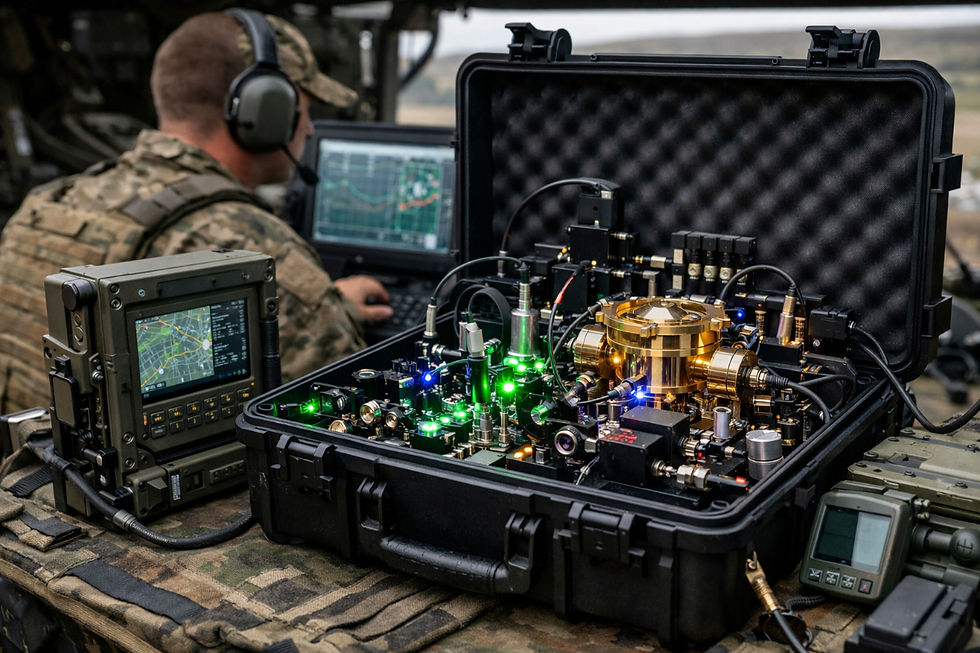
The Defence Science and Technology Laboratory has finished a major field trial of next generation atomic clocks designed to harden military position, navigation and timing systems.
The clocks were tested outside the lab in long duration, unattended conditions closer to deployment. Manufacturers validated core components and full systems under environmental stress instead of pristine research settings. The goal is simple. Reduce dependence on satellite systems like GPS that can be jammed, spoofed, or denied. A while ago UK military started using quantum navigation operating without satellites.
Atomic clocks measure the natural vibrations of atoms energized by light waves, generating frequency stability far beyond conventional electronic clocks. Each system combines a stable frequency source, a counter, and a time output layer. The UK plans follow on trials in 2027 and aims to fly quantum navigation systems, including atomic clocks, on aircraft by 2030.
The disruption behind the news: The end of GPS dependence, satellites lose their monopoly.
Satellites are a single point of failure.
Modern militaries run on timing accuracy measured in billionths of a second.
Whoever owns resilient timing owns the operational edge.
GPS disruption is not hypothetical. In Ukraine, GPS jamming is constant. Commercial aviation and shipping see spoofing incidents weekly in contested regions. A $1,000 jammer can degrade billion dollar platforms.
That imbalance is the opening.
If the UK can deploy compact atomic clocks on aircraft and eventually ships and ground vehicles, it creates a parallel timing backbone. Not perfect independence, but layered resilience. Think of it as redundancy that moves from space to onboard systems.
The adoption mechanism is straightforward. As atomic clock hardware shrinks and costs fall, the marginal cost of embedding precision timing in platforms drops. Ten years ago, deployable atomic clocks were lab bound and power hungry. Now they can be ruggedized and field tested. By 2030, if unit costs fall below $250,000 per system, integration into high value aircraft becomes routine. That is small compared to a $100 million fighter jet.
This also opens the door for domestic suppliers. The trial involved Far Field Exploits, a small UK company testing wireless time and frequency transfer. That is how you seed a sovereign supply chain. Once defense money flows, dual use applications follow in telecom, energy grids, and financial infrastructure.
Timing independence reduces vulnerability to foreign satellite constellations and hostile interference. It lowers operational risk in submarine warfare, autonomous systems, and drone swarms. For example SpaceX and xAI recently joined a secret Pentagon drone technology contest. It strengthens bargaining power in alliances where GPS access has political strings. We also know that Quantum AI is likely to influence military planning before combat.
What to watch next
Watch cost per unit.
Watch power consumption and size.
Watch integration into frontline platforms.
If these clocks remain bulky and expensive, they stay niche. If they shrink fast, they spread across fleets. The 2027 follow on trial is the inflection point. That is where the UK will test specific military scenarios, not just clock performance.
Also watch export policy. If Britain turns this into a controlled but scalable export product, it could carve out a role in allied defense supply chains. A domestic quantum timing industry worth even $2 billion annually by the early 2030s would be strategically meaningful.
Finally, monitor how NATO partners respond. If France and Germany accelerate similar programs, this becomes a European timing stack. If they lag, the UK gains leverage. Quantum is one of the 7 disruptive technologies that will change the world. A while ago we also reported that new quantum sensors promise the next era of communications. Now we have quantum navigation.
This is how you break dependence on fragile space systems, one atomic tick at a time.
Recommended Articles
