
Tesla wants your car connected to space
Tesla (TSLA) may be thinking about vehicle connectivity in a way that bypasses cellular networks altogether.
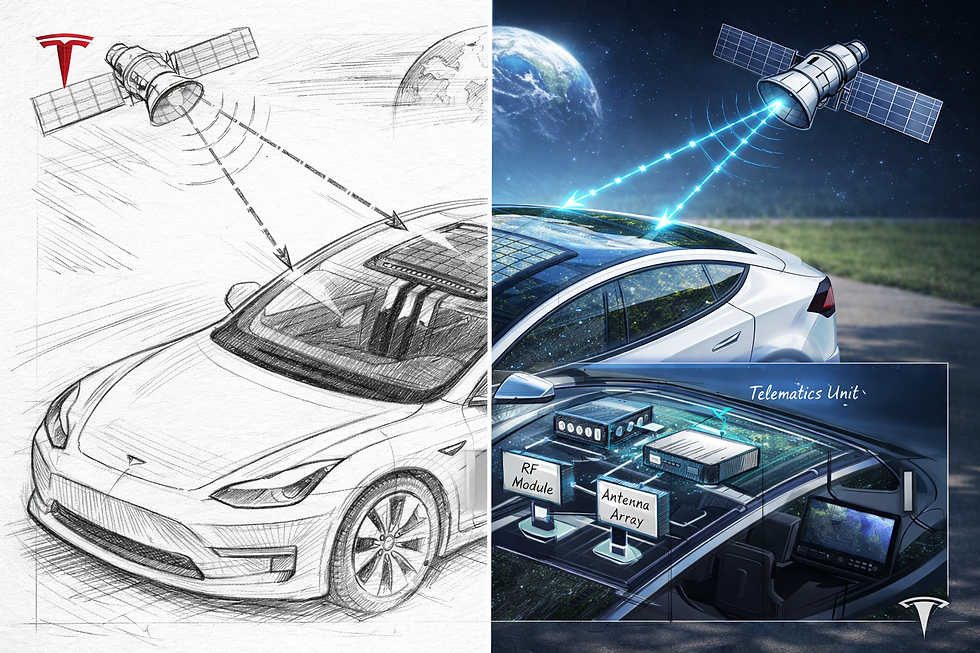
A newly filed patent describes a vehicle roof designed to be transparent to radio frequencies, allowing antennas and other communication hardware to be embedded directly into the structure of the car.
The goal is to let signals pass through the roof without interference, rather than routing everything through external modules or relying solely on terrestrial networks.
The filing doesn’t mention Starlink by name.
But the architecture it outlines—roof-mounted antennas communicating directly with satellites—points clearly toward satellite-based connectivity rather than traditional cellular service.
According to the patent abstract, the roof assembly would house overhead electrical modules and antennae positioned beneath a transparent surface. The drawings show these components integrated cleanly into the vehicle itself, not bolted on or mounted externally. Connectivity becomes part of the car’s structure, not an accessory.
That matters because Tesla’s current setup depends on third parties.
Today, Tesla pays cellular carriers such as AT&T to provide basic connectivity for navigation, software updates, and vehicle functions.
Customers who want more—live traffic visualization, satellite maps, media streaming—pay extra for Premium Connectivity, which still runs over cellular networks.
Cellular works well most of the time. But it has hard limits.
Coverage gaps, congestion, and dead zones remain common, especially outside dense urban areas. Some Tesla owners have already tried to work around those limits by mounting Starlink Mini dishes inside their cars, attaching them to glass moonroofs with suction cups to get high-speed satellite internet on the move.
Those setups are improvised. The patent suggests Tesla is thinking about something native.
By designing the roof itself to accommodate satellite communication, Tesla could remove the need for external hardware and reduce dependence on mobile carriers altogether. Connectivity would be controlled end-to-end, much like Tesla already does with software and vehicle electronics.
That shift would align with broader moves around Starlink.
Earlier this month, Starlink registered a trademark for Starlink Mobile.
It signals continued development of satellite services aimed at phones, vehicles, and other moving platforms.
Electrek, which first highlighted the patent, noted that bringing connectivity in-house could give Tesla more control over performance, pricing, and features.
It would also allow the company to treat connectivity as a core vehicle capability rather than a subscription layered on top of someone else’s network.
Patents don’t guarantee products, and Tesla files many ideas that never reach production.
But this one fits a pattern. Tesla has consistently pulled critical systems under its own control when the technology allowed it. Satellite connectivity may be reaching that point.
Tesla (TSLA) has a Disruption Score of 0.
Recommended Articles
