
News
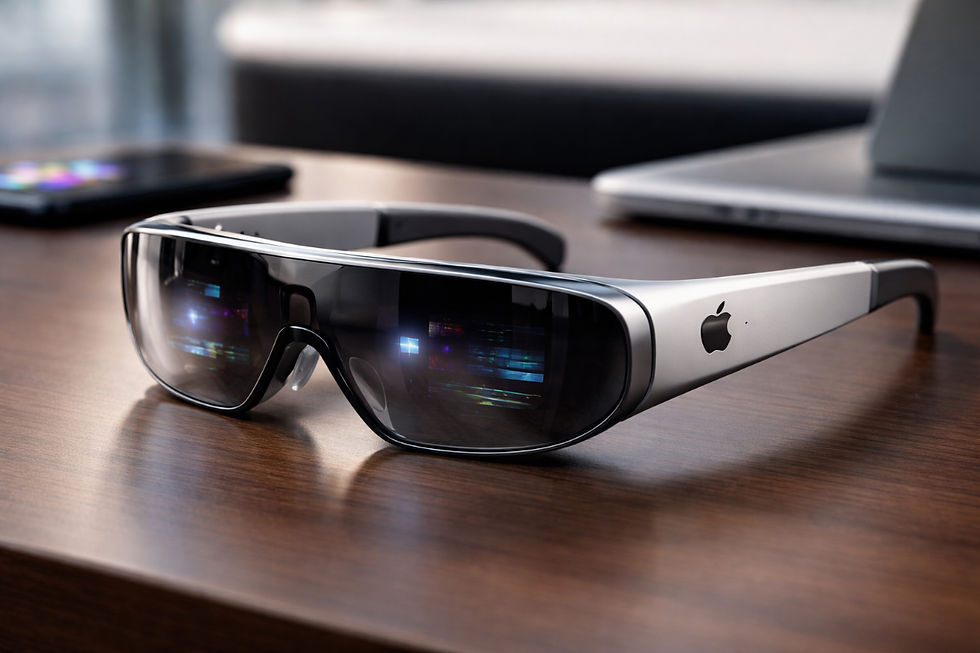
Apple speeds up smart glasses plans to rival Meta Ray-Bans
Disruption snapshot
Apple is shifting from its $3,500 Vision Pro to sub-$1,000 AI wearables. It’s speeding up smart glasses, a pendant device, and AI-focused AirPods to compete with Meta’s $399 glasses.
Winners: Meta Platforms and low-cost AI hardware makers gain scale and data. Losers: Apple Inc. if Siri lags, and premium-only headset models priced above $1,000.
Watch Apple’s launch price. If glasses land under $500, they can scale fast. If pricing stays near $1,000, adoption may stall and Meta keeps its lead.
Meta (META) and Apple (AAPL) have a Disruption Score of 4 and 2, respectively.
Apple (AAPL) is speeding up development of smart glasses to counter Meta’s (META) runaway success with Ray-Ban AI eyewear priced under $500.
After the $3,500 Vision Pro failed to break out beyond early adopters, Apple is pivoting hard toward lighter, cheaper, AI-first wearables.
The company is accelerating three products. Smart glasses. A pendant device worn around the neck. And upgraded AirPods built around Siri. All of it hinges on putting AI directly on your body.
That urgency comes with baggage. Apple’s long-promised Siri overhaul has reportedly hit delays. So the very assistant meant to power this new category is still under construction. Meanwhile, Meta has already shipped millions of AI glasses and is building real-world usage data at consumer scale.
The disruption behind the news: Apple’s $3,500 lesson, the smart glasses revolution starts at $399
This is Apple admitting that spatial computing at $3,500 was a science project.
The mass market is happening at $299 to $499, not at luxury price points.
Meta understood that smart glasses don’t need holograms floating in your living room.
They need cameras, microphones, speakers, and AI that answers questions in real time. That’s good enough to change habits.
Here’s the cost curve reality. A $3,500 headset has a tiny addressable market. Even if Apple sold 500,000 units a year, that’s under $2 billion in revenue. Meta’s glasses, at $399, can realistically sell 5 million units annually if demand holds. That’s the same revenue, but with 10 times the user base generating data, developer interest, and brand momentum. Scale wins ecosystems.
If Apple brings glasses to market in 2027 or 2028, it will be entering a category where Meta may already have tens of millions of users. That creates switching costs. Your AI assistant learns your voice, your routines, your photos. The more data it has, the harder it is to leave. Apple’s historical advantage has been integration. But integration only matters if people are wearing the device.
The pendant device is even more telling. That suggests Apple sees ambient AI as bigger than screens. A camera and microphone hanging around your neck feeding context into Siri could turn AI into a continuous layer over daily life. That shifts competition away from phones and toward whoever controls always-on intelligence. So we can again ask the question: Can AI glasses replace our phones?
For businesses, this means the next computing platform isn’t a visor, but lightweight hardware plus cloud AI. Retail, field service, logistics, healthcare. Anyone with workers who need hands-free information should be prototyping now. The hardware will get cheaper every year. The AI models will get better every quarter. Waiting means playing catch-up in a market where early data compounds. AI is one of the 7 disruptive technologies that will change the world.
What to watch next
First, pricing.
If Apple can’t get glasses below $1,000, it loses before it starts. The difference between $499 and $999 is the difference between impulse tech and niche gadget.
Second, Siri’s upgrade timeline.
If the assistant slips another year, Apple risks shipping beautiful hardware powered by mediocre intelligence. That would be fatal in an AI-native category.
Third, developer tools.
Watch for Apple to open APIs for camera-based AI, contextual search, and live translation. The company that builds the best third-party ecosystem around wearable AI will own the platform.
Apple is racing Meta now. But this is about who controls the AI layer that sits between you and the world. If Apple misses this cycle, it won’t just lose a product category. It will lose the next interface.
Meta (META) and Apple (AAPL) have a Disruption Score of 4 and 2, respectively. Click here to learn how we calculate the Disruption Score.
Meta is also part of the Disruption Aristocrats, our quarterly list of the world’s top disruptive stocks.
Recommended Articles
