
News
China’s humanoid robots take center stage at Spring Festival Gala
Disruption snapshot
China turned its biggest TV event into a live humanoid robot showcase. It signals social approval. Robots are moving from factories into homes, hospitals, and malls.
Winners: Chinese humanoid robot makers like Unitree Robotics and AI platforms like ByteDance. Losers: Labor-intensive sectors and foreign rivals like Tesla racing to scale humanoids.
Watch average selling prices. If they fall below $20,000 per robot, fleet adoption in logistics and elder care could surge. Also track state procurement in hospitals.
China just turned its biggest television event into a demo for humanoid robots.
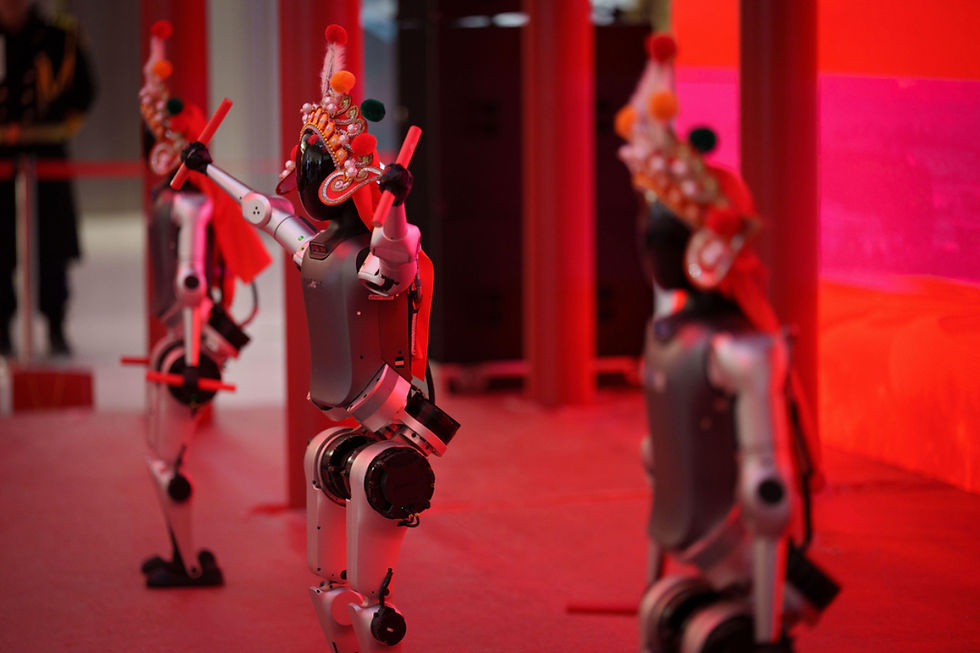
At this year’s CCTV Spring Festival Gala, watched by 79% of China’s live TV audience, humanoid robots from Unitree Robotics, Galbot, Noetix and MagicLab didn’t just make cameo appearances.
They headlined comedy sketches.
They performed martial arts routines with swords and nunchucks.
They fell, staggered through drunken boxing moves, and stood back up in sync. They danced to “We Are Made in China.” ByteDance’s AI chatbot Doubao showed up too.
This was prime time Lunar New Year programming, the Chinese equivalent of the Super Bowl halftime show. And it was a signal. China leads the US in humanoid robotics startups.
China shipped roughly 13,000 humanoid robots globally last year, about 90% of the world’s total, according to Omdia. Morgan Stanley expects domestic sales to top 28,000 units this year. Unitree and AgiBot are lining up IPOs. President Xi Jinping has personally met robotics founders. The state is wrapping this sector in political legitimacy and consumer spectacle at the same time.
The disruption behind the news: This is about robots getting social permission.
Humanoid robots have always faced a deployment wall.
Factories are controlled environments.
Homes, malls and hospitals are not.
For robots to move from industrial arms in cages to human-shaped machines in public spaces, people have to feel comfortable standing next to them.
Watching a dozen robots swing weapons next to children on national television is a mass desensitization event. It tells 1.4 billion people that these machines are safe enough.
That matters because cost curves are finally bending. If shipments double from 13,000 to 28,000 in a year, that implies early scale effects. Even a modest 20% drop in bill of materials at those volumes can unlock new use cases in logistics, retail and elder care. China’s aging population makes this urgent. The working-age population has been shrinking since 2012. Labor-intensive sectors are already tight.
The state’s AI+ manufacturing strategy isn’t abstract. It’s a plan to swap labor with embodied AI at national scale. By showcasing multi-robot coordination and fall recovery, these companies are advertising reliability, not novelty. If a robot can fall on stage and get back up, it can fall in a warehouse aisle and keep working. Alibaba recently unveiled RynnBrain AI model to power next-generation robots.
There’s also a capital markets play. IPO-bound robotics firms need retail excitement. Turning founders into gala celebrities is free marketing and policy insurance. When these stocks list, they won’t just be hardware companies. They’ll be national champions.
And yes, Elon Musk should be paying attention. We are wondering if Tesla is shifting its strategy toward AI and robotics? Tesla’s Optimus ambitions hinge on software intelligence meeting affordable hardware. China is attacking both at once, with state backing and domestic demand.
What to watch next
Watch unit economics.
If average selling prices drop below $20,000 within 24 months, adoption will move from pilot programs to fleet orders.
Watch for government procurement targets, especially in state hospitals and logistics hubs.
And watch how quickly Chinese platforms integrate robots with domestic AI models.
Embodied AI is only as good as its brain. AI and robotics are two of the 7 disruptive technologies that will change the world.
Most of all, watch for normalization.
The first time a humanoid robot replaces a night shift in a public hospital, it won’t feel shocking. It’ll feel inevitable.
China robots are being placed in the living room. Once they’re there, they’re not leaving.
Recommended Articles
